Why a scar can pull, itch or hurt
After surgery or an injury, the body forms scar tissue. Its collagen fibres are arranged differently from those in the surrounding skin. The scar may stretch less easily or be more firmly attached to the tissue underneath. You might feel a pulling sensation, for example when you bend a joint.[1–3]
A scar can also itch, hurt or feel numb. If even light touch feels uncomfortable, sensitive nerve endings in the skin may play a role. This can feel like burning or tingling.[1, 4]
When might scar mobilisation help?
If the skin at a healed scar feels tight and pulls during movement, mobilisation can be part of your physiotherapy. One aim is to help the skin glide more easily over the tissue underneath so that the movement feels more comfortable.[3, 5]
Finding out what affects you day to day
We ask when you notice the scar and which movements you find difficult. Depending on how the wound has healed, we check how freely the skin moves and how it responds to touch. You can ask us which movements are suitable for you while the wound is still healing.[1, 9]
Mobilising the healed scar gently
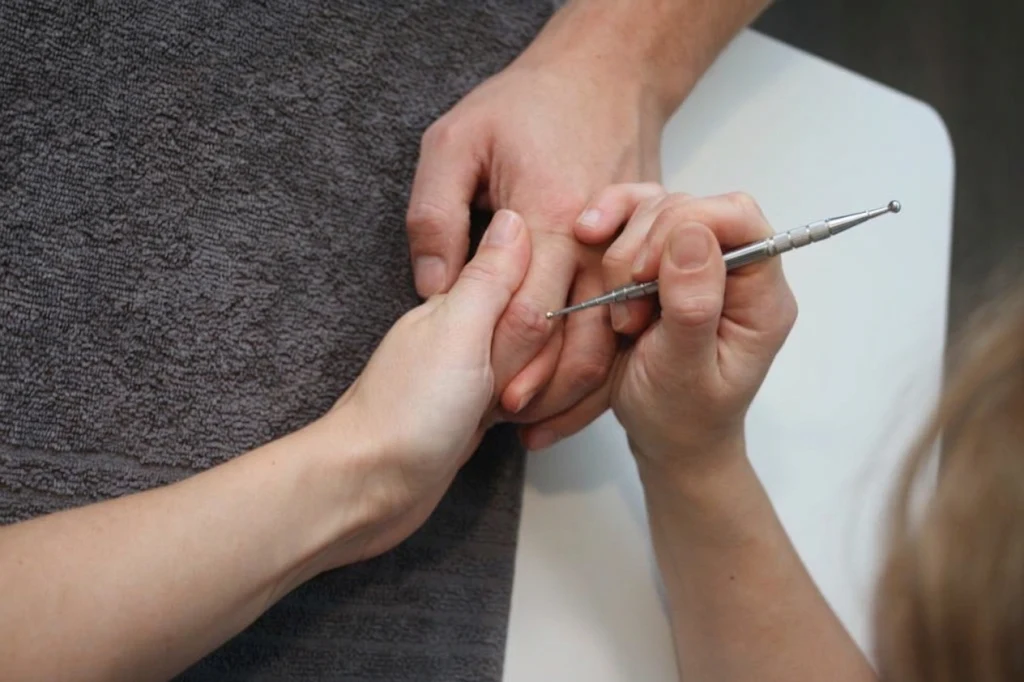
Once the wound has fully healed and the skin can tolerate gentle pressure and movement, we can work directly on the scar. We use our hands to move the scar and the skin around it. We adjust the pressure to what feels comfortable for you and follow your care team's advice after surgery.[1, 8]
Getting used to touch and movement gradually
If touch feels uncomfortable, we can help the healed area gradually get used to it. We may add movement exercises based on our assessment. We focus on what you want to do more easily in daily life, such as bending your knee on the stairs or raising your arm when getting dressed.[1, 4]
Sources and clinical background
The hospital pages explain possible symptoms and aftercare. Tissue studies describe how scars are structured. Clinical studies and research reviews examine possible effects of treatment.
- Royal National Orthopaedic Hospital: Scar care after surgery. Patient information on how scars change, sensitivity and gentle massage once the wound has fully healed.
- Van Zuijlen et al. (2003): Collagen in human skin and scar tissue. This study of tissue samples found that collagen fibres are arranged differently in scars and uninjured skin.
- Guy’s and St Thomas’ NHS Foundation Trust: Scar care after hand injuries and surgery. Explains how the skin moves over the tissue beneath it and how scars over a joint can restrict movement.
- Great Ormond Street Hospital: Scar desensitisation. Explains the role of nerve endings and how to get used to touch gradually.
- Scott et al. (2022): Review of scar massage after surgery. Suggests possible benefits for pain, movement and scar characteristics. The studies used different treatments and measures, and many included other rehabilitation interventions.
- Olszewska et al. (2024): Manual treatment of caesarean scars. A small randomised study with 30 participants. On average, caesarean birth was 14 months earlier. After four weeks of treatment, the groups differed in skin scar pliability and stiffness. There was no statistically clear benefit for self-reported pain (Tables 1–3).
- Gilbert et al. (2022): Mobilisation of caesarean scars. A study with 32 participants and no control group. Two treatments were followed by short-term changes in stiffness and pressure pain threshold at the skin scar.
- Di Serio et al. (2025): Review of physiotherapy for skin scars. Section 4.5 discusses massage. Many studies were about burn scars. The techniques varied, and the authors called for further research.
- NHS: Recovering after a caesarean birth. Describes gentle activity early in recovery, such as short walks.
Helping you get back to everyday life.
Our team brings together experience in orthopaedics and surgical care. We discuss how scar mobilisation could fit into your physiotherapy.
Current research on scar treatment
We keep up with research on scar treatment. We look at which symptoms the studies examined and which findings may be relevant to your care.
Exchanging knowledge with dermatologists
We exchange knowledge with practising dermatologists. Their perspective on scars and the symptoms they can cause informs our work.
Your feedback matters.
Tell us how touch and movement feel. We adjust the pressure and the extent of treatment based on your feedback.